Queer Deities in Migration is a multidisciplinary research and performative creation project curated by Georgian artists Giorgi Papalashvili, Uta Bekaia, and Dato Koridze, which explores the relationships between queer identity, migration, cultural memory, and the mythological heritage of the Caucasus. Through the intersection of performing arts, visual practices, costume and mask making, and the reimagining of ancestral rituals, the project investigates art’s potential to shape alternative narratives of identity, belonging, and displacement.
At the heart of the research is a dialogue between the contemporary experiences of seven queer migrant individuals and seven ancient gender-fluid deities from the Caucasian mythological tradition. The project stems from a reflection on the conditions of marginalization, discrimination, and forced migration affecting LGBTQIA+ communities in the Caucasus region, connecting them to a cultural and symbolic heritage in which gender fluidity historically found expression through divine figures and mythological archetypes. This connection between past and present allows queer identities to be reinterpreted not as elements alien to their cultures of origin, but as expressions deeply rooted in their most ancient traditions.
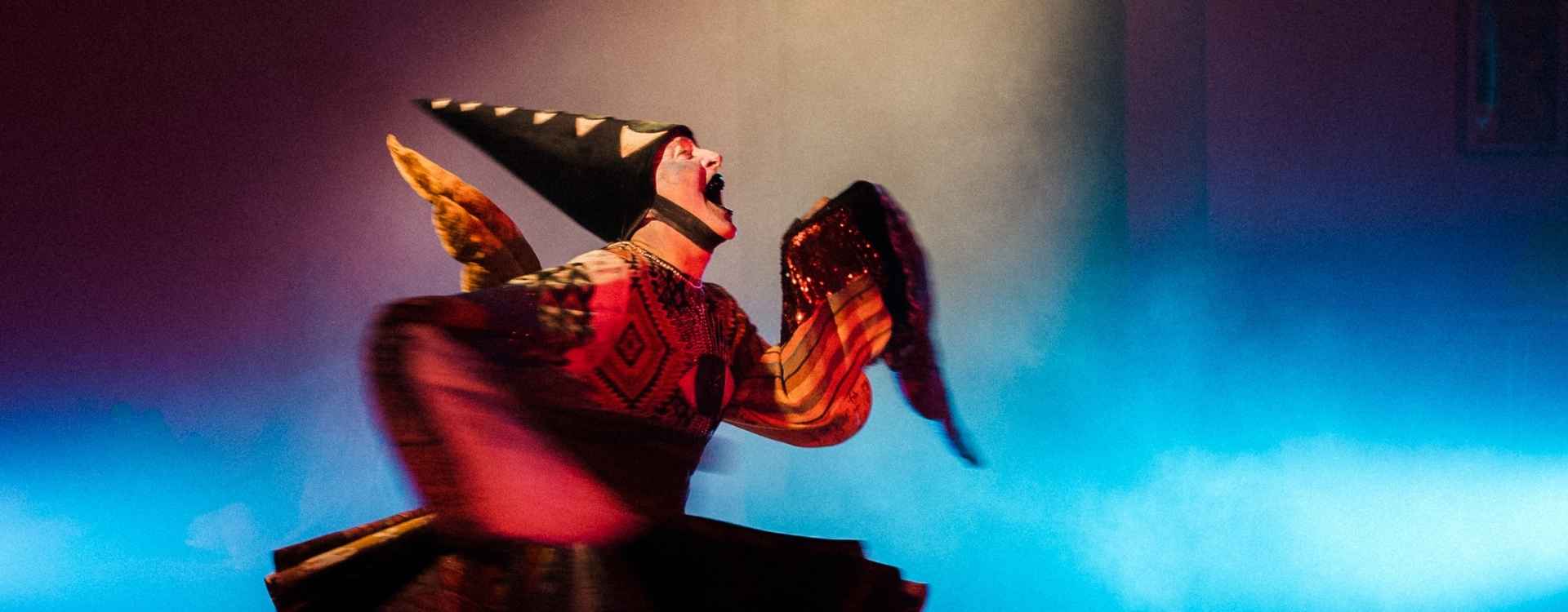
The artistic research thus develops around the possibility of reclaiming a cultural and mythological imagination, transforming it into a contemporary tool for self-representation and self-determination. The personal stories of the participants interact with those of the deities, giving rise to new hybrid figures in which biography, memory, myth, and invention overlap. Costumes, masks, gestures, and ritual actions play a central role in the creative process—not merely as scenic elements, but as vehicles through which the body can navigate and transform its identities, experiment with new forms of presence, and make visible experiences often excluded from dominant narratives.
From August 24 to September 13, 2026, BASE Milano hosted a residency for the artistic collective, composed of Giorgi Papalashvili, Giorgi Megreshvili, David Koridze, Uta Pata Bekaia, and Ismail Pasha-Sade. The residency period represented a phase of development and deepening of the research, offering a dedicated context for experimentation and for constructing a performative language capable of bringing together different artistic practices and sensibilities.
The residency allowed the work to focus on the relationships between the autobiographical dimension and symbolic representation, delving into the expressive potential of performance as a meeting point for different bodies, stories, and cultural imaginations. The creative process developed through the integration of visual, bodily, and ritual elements, paying special attention to the capacity of objects, garments, and masks to become narrative and transformative tools. In this perspective, the research was not limited to producing a stage outcome, but valued the artistic process itself as a space for collective reflection, exchange, and the creation of new meanings.
Hosting the project aligns with BASE Milano’s broader commitment to supporting international artistic mobility, interdisciplinary research, and cultural practices capable of questioning contemporary social transformations. The residency offered an opportunity to welcome and enhance artistic perspectives from diverse geographical and cultural contexts, contributing to the circulation of artistic languages and narratives addressing central issues in contemporary discourse—such as the right to self-determination, freedom of expression, identity plurality, and the relationship between cultural belonging and the migratory experience.
In this sense, the dimension of migration assumes particular significance, understood not merely as an experience of distance from one’s land of origin, but as a process of redefining bonds with memory, language, tradition, and community. Through the recovery and reinterpretation of Caucasian mythological figures, “Queer Deities in Migration” proposes a reflection on the possibility of reconstructing a sense of belonging even from experiences of discontinuity, exclusion, and diaspora. Performance thus becomes a space to imagine new genealogies, recognize plural identities, and restore visibility to often marginalized stories and subjectivities.
On September 12, 2026, the research journey culminated in a public presentation within FAROUT Live Arts Festival, the festival dedicated to contemporary performing arts promoted by BASE Milano. The presentation made it possible to share with the public the outcomes of the experimentation developed during the residency, placing the project within an international programming context focused on exploring new artistic languages and encouraging critical reflection on the present.
Its inclusion in the FAROUT program provided an important opportunity for dialogue between the collective’s research and the festival audience, broadening the possibilities for discussion around the topics addressed by the project. Furthermore, the public presentation highlighted the continuity between the residency work—conceived as a protected period for experimentation and production—and its opening up to the public sphere, where artistic practices can generate opportunities for awareness, education, and intercultural dialogue.
The research was supported by the European Commission and the Goethe-Institut within the framework of Culture Moves Europe, a European program dedicated to the international mobility of artists and cultural professionals. This support helped enable a path of transnational artistic exchange and production, fostering connections between different cultural contexts and reinforcing the role of mobility as a tool for professional growth, experimentation, and international cooperation.
Overall, Queer Deities in Migration residency contributed to BASE Milano’s goals of promoting artistic research as a space of freedom, experimentation, and the creation of new cultural representations, supporting practices capable of challenging established narratives and providing visibility to underrepresented experiences and identities. Additionally, the project highlighted the value of artistic residencies as support infrastructures for contemporary creation—not merely venues for producing works, but contexts in which to build relationships, process knowledge, and foster connections across different disciplines, communities, and imaginations.