
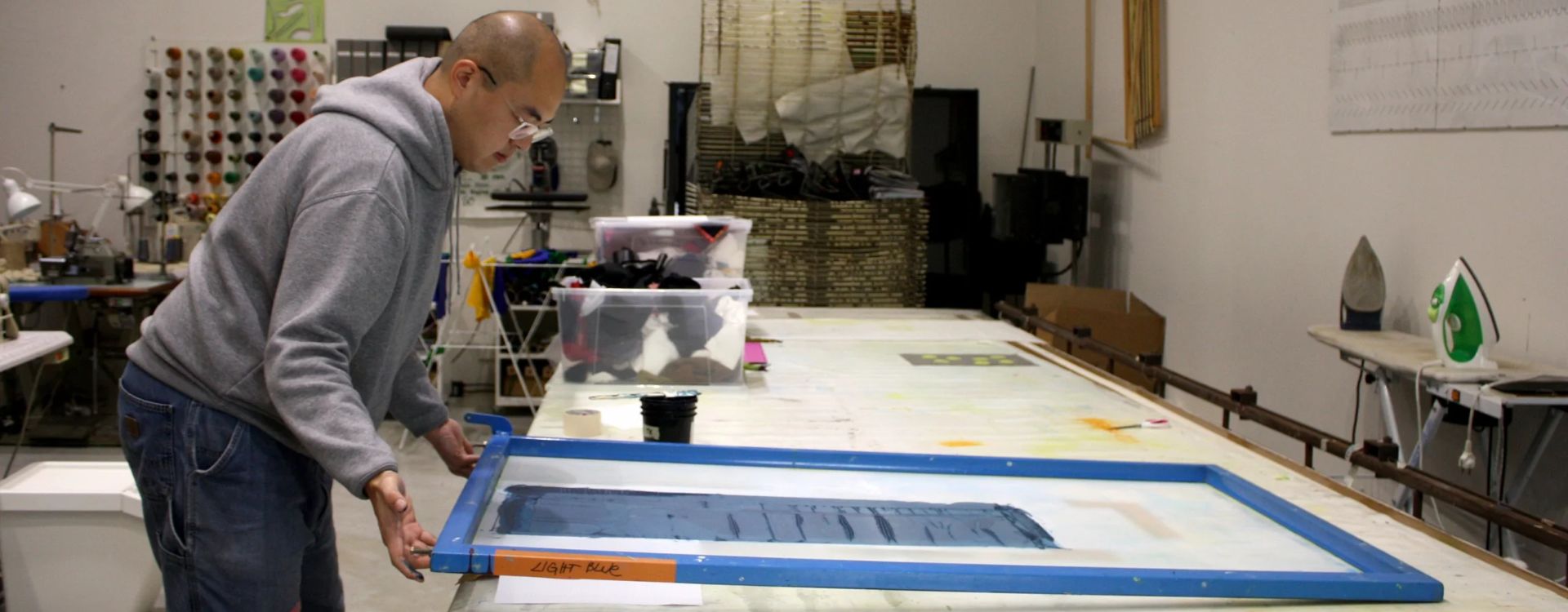
From 16 to 20 November 2026, Lottozero in Prato hosted Taiwanese artistic researcher Anas Chao for a first research visit. It is the opening chapter of a project conceived and promoted by BASE Milano, which will arrive at Milan Design Week 2027.
Anas Chao is an artistic researcher based between Taiwan and the Netherlands. Using ethnographic and artistic approaches, he explores how identities are produced and maintained in contemporary society.
His new project, Parallel Entanglements, looks at how personal and regional identities are preserved in a globalised world. It sets the shifting industries and heritage of Prato alongside the revival of Indigenous Amis weaving traditions in Taiwan. Between the two, Anas traces the threads linking cultures across continents, and the divides that can exist between neighbours.
Two textile cultures
The Indigenous Amis people of Taiwan have traditionally passed down their history and teachings through oral narratives, songs, rituals and textile patterns. Weaving is a vital medium for preserving ancestral knowledge, turning local materials into everything from daily accessories to ceremonial garments. Historical colonisation and external cultural influences have altered or erased much of this heritage.
In recent decades, a growing awareness of Indigenous rights has spurred efforts to recover ancient techniques and trace missing histories. The weaving atelier Nu Babahi A Demak, founded in Hualien in 2021, emerged from this movement. It is run by local women, including descendants of the Cikasuan group alongside Atayal and Bunun weavers.
The atelier handles the entire production cycle, from growing ramie and hand-dyeing threads to weaving traditional and contemporary textiles. Through educational programmes and workshops, it works to revive, preserve and share Indigenous weaving knowledge.
Over the centuries, Prato has grown from a small wool-producing town into a fast-fashion hub and a leader in sustainable textile manufacturing. Some high-end manufacturers have kept their historic prestige, while much of the traditional industry has relocated or closed in the face of foreign competition.
At the same time, foreign investors and workers, predominantly Chinese, have built on local infrastructure to expand fast-fashion businesses. For surviving local companies, niche markets and sustainable production have become essential. Prato remains anchored in the post-globalisation supply chain and relies on imported materials, and this coexistence of economic models and cultural practices keeps reshaping the identities of its residents and industries.
The residency
During his first visit, Anas explored Lottozero’s laboratory, archive and local supply chain, identifying materials, techniques and possibilities for experimentation. The visit lays the groundwork for fieldwork in Taiwan and a later production residency at Lottozero.
At Nu Babahi A Demak, he will study Amis weaving techniques and collect the stories behind their patterns. At Lottozero, he will look at the impact of globalised textile production in Prato and at the sourcing of recycled materials.
Anas will then translate his research into a textile artwork in Taiwan. The work will travel to Prato, where its production continues with the materials and machinery available at Lottozero.
The finished work will be presented at BASE Milano duringMilano Design Week 2027 as an installation. It will be accompanied by workshops inviting visitors to collectively create a site-specific artwork reflecting shared values and stories.
About Lottozero
Founded in Prato in 2016, Lottozero is a centre for textile research, design and culture. Its equipped laboratory, shared studios and exhibition space connect artists and designers with the skills and resources of one of Europe’s leading textile districts.
Its international residency programme hosts creatives on research and production journeys, offering access to machinery, technical guidance and exchange with local artisans and companies. From weaving and knitwear to dyeing and embroidery, the centre supports experimentation with materials and the development of samples, prototypes and works.
Through Lottozero Studio, it also offers textile consultancy and development, with a focus on circularity and on bringing textile archives and heritage into a contemporary language.