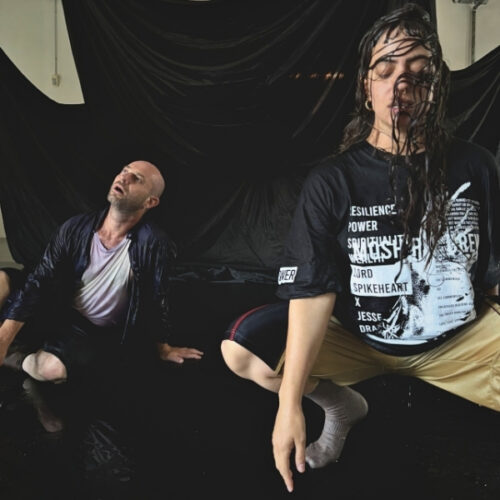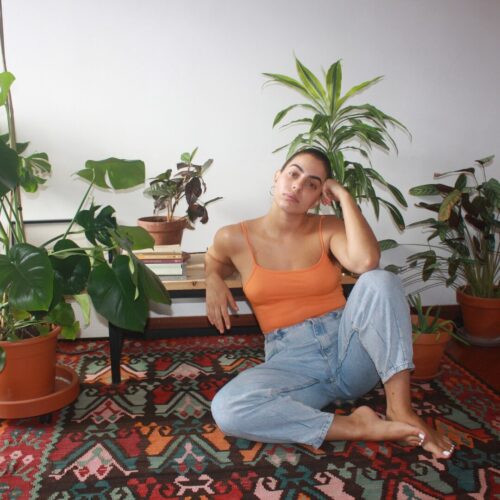
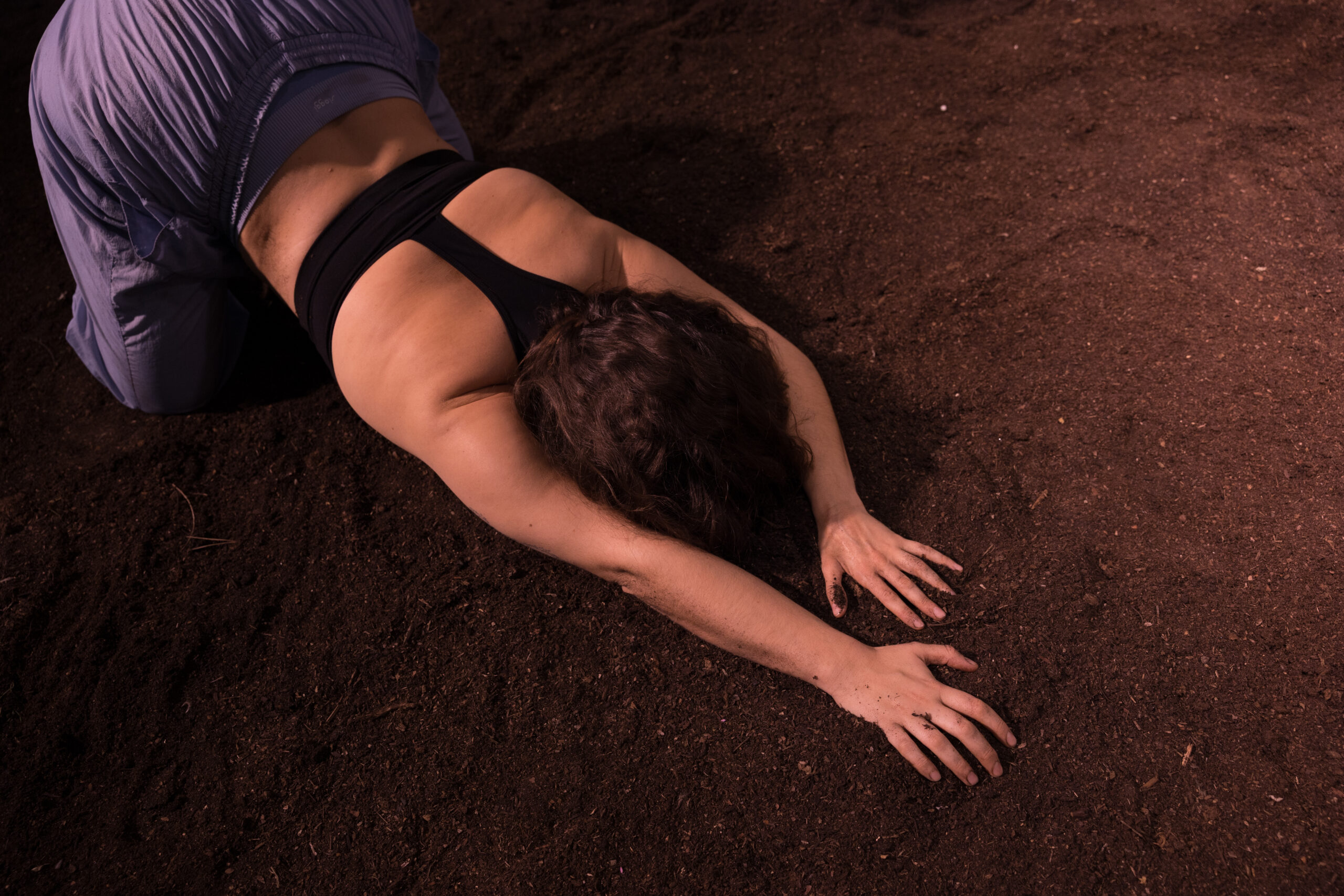
An elegy, a prayer,
it carries the tone of tragedy.
A liturgical chant for all that is returning to Earth, to be transformed.
A communion with the spirits,
an elemental way of being in the body.
Whatever I am / let it be seen is the translation from Turkish of a prayer traditionally recited before beginning the coffee grounds reading.
What I am doing is literal. I am happy about it.
In the face of horror, I can only be literal.
Energy is a literal thing.
We are designing a ritual communion,
a moment, a situation.
At a time when we are called to feel more than ever the crushing weight of what can no longer be, I turn to the body and its experience, anchoring a sensitive and necessary, transformative perception.
I want to start from dance as an inexplicable, unjustifiable, perceptible, liveable, and traversable practice, designing it as a complete, perhaps ancient, experience.
Giving space to the excellent knowledge that is being in the body, which does not need to be contextualized, imagining freeing it from the tight yoke of the relationship with theory, context, and justification.
A funeral for all the things we can no longer bear.
Credits
by Giorgia Ohanesian Nardin
with F. De Isabella, Giorgia Ohanesian Nardin, Lele Tori
dance Giorgia Ohanesian Nardin
text Giulia Crispiani, Giorgia Ohanesian Nardin
writing collaboration F. De Isabella, Lele Tori
vision and movement support Elena Giannotti
questions and dramaturgy support Jamila Johnson-Small
costume design and manufacturing Max Simonetto naturaviolenta
soundscape F. De Isabella
lighting design Giulia Pastore, Elena Vastano
technical design and production Elena Vastano
curation, management, and production Giulia Traversi
ph. and video by Roberta Segata, Courtesy Centrale Fies
Giorgia Ohanesian Nardin is an Italian artist of Armenian descent who works in the context of dance and live performance.
Trained in dance, her work manifests itself in movement, video, text, choreography, sound, and gatherings, and explores the relationship between dance, divination, and writing; geography and the opposite of belonging; and the fetish for language, its politics, and its many frictions.
Trained in classical dance and subsequently earning a BA from the Northern School of Contemporary Dance (Leeds, UK), she began composing in 2010 with Marco D’Agostin and Francesca Foscarini, with whom she founded the VAN Cultural Association (2014).
Her work, “All Dressed Up with Nowhere to Go,” was the number one work selected for the prestigious Aerowaves ’15 network and has toured extensively nationally and internationally.
Giorgia was the first Italian artist selected for a production residency at K3 Zentrum fur Choreographie Hamburg, where she created Season, a quartet on the pornography of the gaze.
In 1916, she was commissioned by the CSC of Bassano del Grappa (along with Yasmeen Godder, Yoko Higashino, and Melanie Demers) to create a work inspired by Vivaldi’s Stabat Mater. The work involved a group of women aged 40-80 from the group Dance Well – movement research for Parkinson’s. Between 1915 and 1917, she was an associate professor at Balletto di Roma, where she also created a version of L’après-midi d’une faune for the company. In 2017, she created Minor Place, a participatory performance inspired by a reading of Caliban and The Witch – Women, the Body, and the Originary Accumulation (Silvia Federici).
Since 2018, she has regularly held Pleasure Body, a space facilitating practices related to well-being and relaxation. Pleasure Body has been touring nationally and internationally for seven years, from cultural institutions to museums, universities, and festivals.
Giorgia has been invited to perform Pleasure Body at, among others:
Harvard University, Siobhan Davies Studios, Saison Foundation Tokyo, Gropius Bau Berlin, and Sophiensaele.