
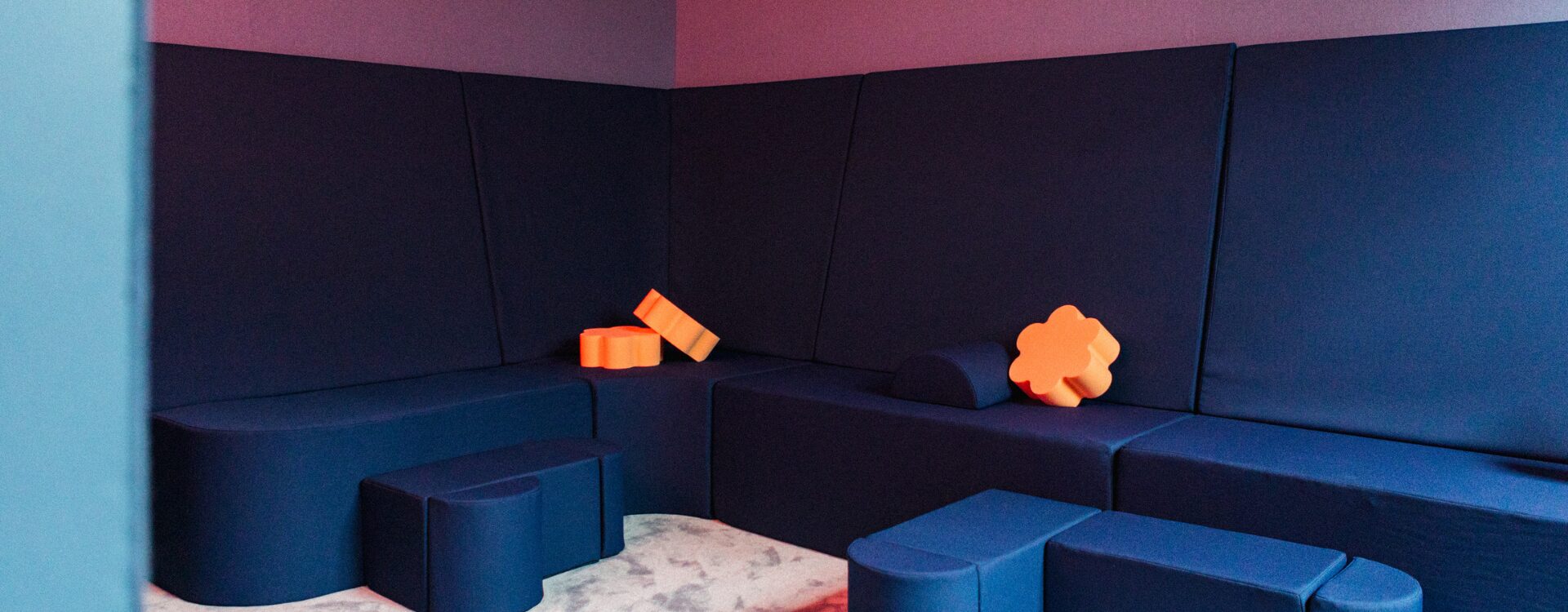

A shelter architecture for public space
A new permanent space dedicated to accessibility, care, and the possibility of experiencing BASE at your own pace, in ways that respond to your needs.
BASE, Entrance A
Ground floor / Bistro area
A quiet, sheltered and accessible space, created as a place to pause, regain a sense of calm, and experience the cultural space freely and in your own way.



It accommodates a wide range of uses and needs: from sensory decompression and emotional regulation to moments of solitude, prayer and breastfeeding, as well as the simple need to take a break.
A new step in the path we have been following for years around accessibility and inclusion, expanding the ways in which people can take part in cultural life.
Accessibility, in fact, is not only about removing barriers. It means designing spaces that can welcome the plurality of people, bodies, sensitivities and ways of experiencing public space. From this perspective, QUIET ROOM is a cultural infrastructure: a space designed to make broader participation possible, recognising that everyone experiences a cultural space differently.
In a context still often shaped around an implicit idea of who the public is, QUIET ROOM offers a different perspective: creating the conditions for everyone to feel recognised, welcomed and entitled to be there. Because taking part in cultural life also means being able to slow down, take care of yourself or others, and choose how to inhabit a shared space.
Designed by Studiolatte and created in partnership with Slalom Acoustics, QUIET ROOM takes the form of an architecture of shelter: a soft, immersive environment defined by a large textile covering that envelops the space.
Through acoustic design, the study of light and the use of soft, continuous surfaces, the project creates a landscape dedicated to wellbeing. A constellation of informal elements invites people to explore the space freely, creating a threshold between the public and the private, between activation and quiet.
QUIET ROOM gives concrete form to the path BASE Milano has been following, gradually redefining its approach to cultural accessibility. This vision is set out in An “Unexpected” Idea of a Cultural Center, developed through a process of dialogue with multiple stakeholders, including professionals, researchers, organisations and people with different experiences and needs.
From this perspective, accessibility is not only about removing barriers. It also means designing cultural institutions that recognise plural perspectives, challenge privilege and marginality, and use space to create new forms of belonging and participation. QUIET ROOM is one of the ways this vision takes shape, contributing to a cultural institution that is more open, situated and capable of embracing multiple differences, needs and temporalities.