
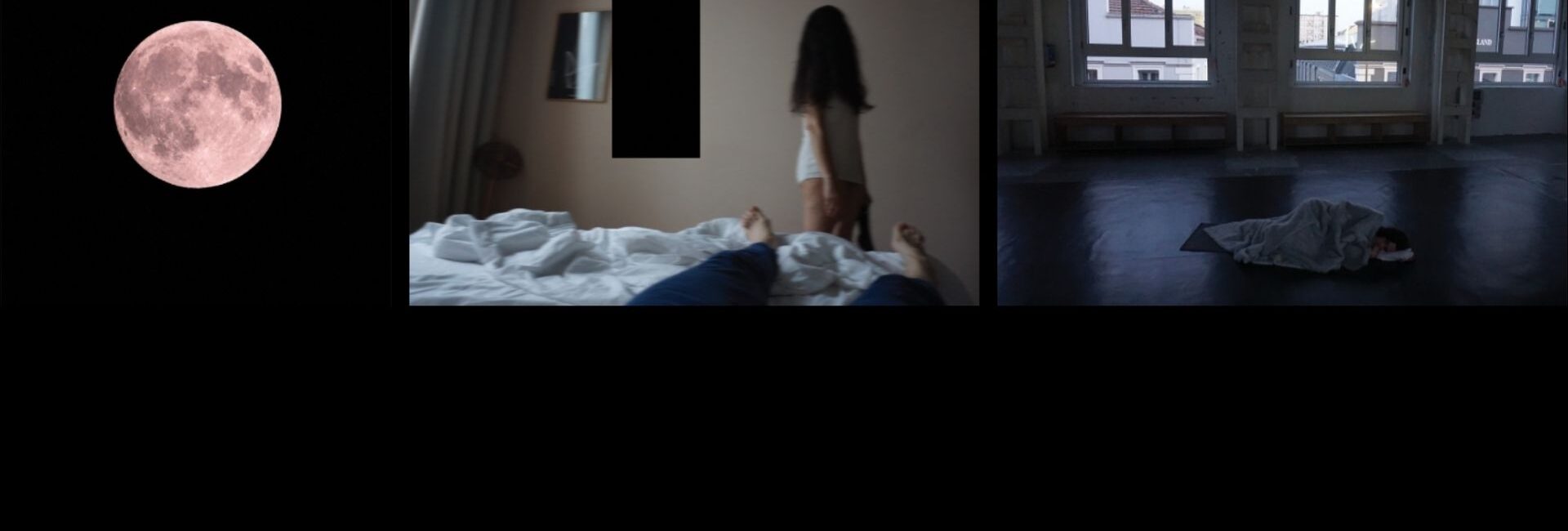
A nocturnal encounter, a non-straight temporality that thickens, returns, deviates — lingers, expands, gets lost. Between waking and sleep, fear and desire, stillness and transformation, Calderoni and Caleo sink into the night, a material to inhabit, devour and displace elsewhere.
Accompanying this descent into darkness are the words of Monique Wittig and Sande Zeig from Lesbian Peoples: Material for a Dictionary, while the line that gives the research its title comes from Alejandra Pizarnik, an Argentine lesbian poet who died by suicide.
At the deepest point of the night, other cosmologies emerge: packs, hordes, swarms; mares, she-wolves, lionesses, marmots and snakes. Two bodies become many and, as in Wittig and Zeig’s text, entire populations gather. Boundaries become porous, and on bodies always on the verge of falling asleep appear antennae, hair, feathers, paws, claws, scales and mouths.
La notte ha la forma del grido di un lupo withdraws from the urgency to move forward, produce, or get somewhere. Because here, duration is a matter of resistance: to last one moment longer than those who want us dead, to endure one more night. And perhaps it is precisely in the darkness, when familiar forms begin to lose their contours, that we might glimpse the glow of other possible worlds.