
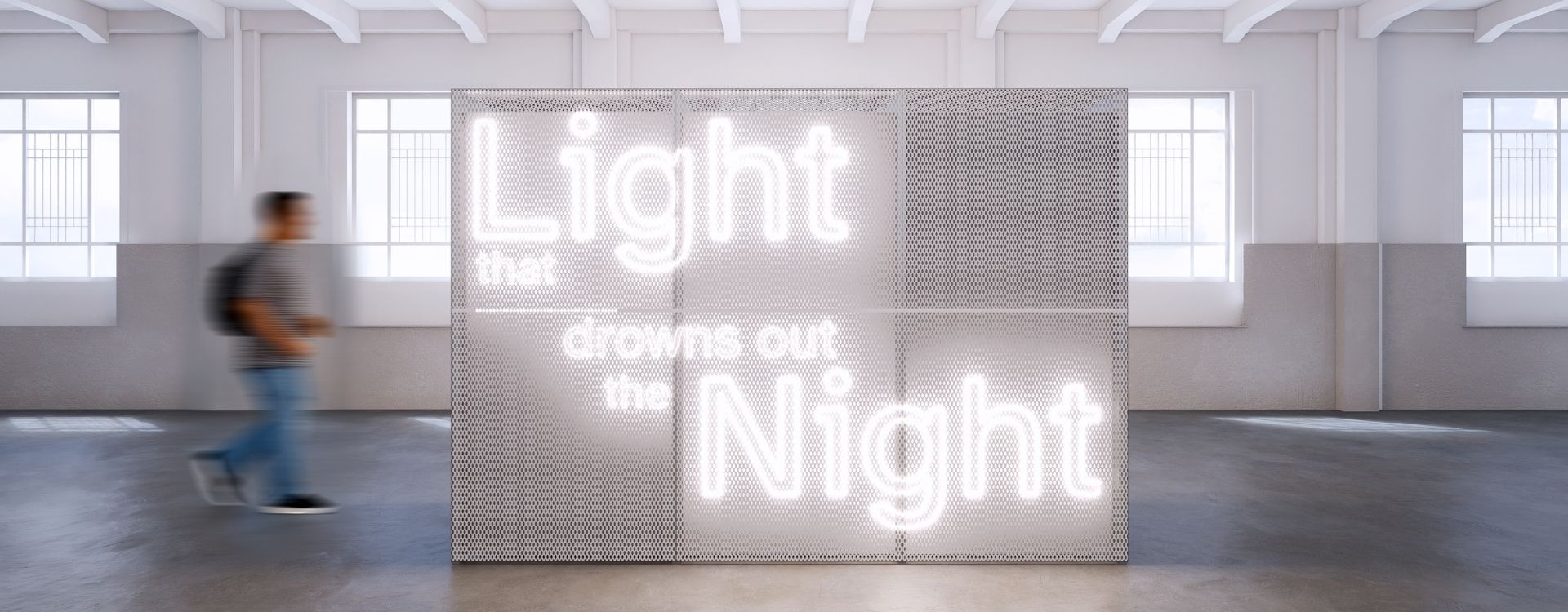
The installation addresses light pollution as a largely invisible phenomenon shaping contemporary cities and ecosystems.
It takes the form of a closed, opaque corridor, externally covered with neon signs and a message that evoke the hyper-exposed urban night.
Inside, darkness becomes a threshold, guided only by a minimal moving LED.
Meaning emerges not through illumination but through its absence: when the LED turns off, a hidden text becomes visible. The project invites visitors to physically encounter what excessive light has progressively erased.
––––
We Will Design 2026 — HELLO, DARKNESS embraces design as a tool for subverting hierarchies and weaving together ecologies and technologies to imagine the cities and societies of the future.
It is an invitation to recognize the abyss — political, ecological, aesthetic — we’re living in, not as a place of fear, but as a space of regeneration, resistance, and imagination. Darkness here is not absence, but a fertile condition that embraces invisible gestures, marginalized knowledge, and luminous forms of resistance.